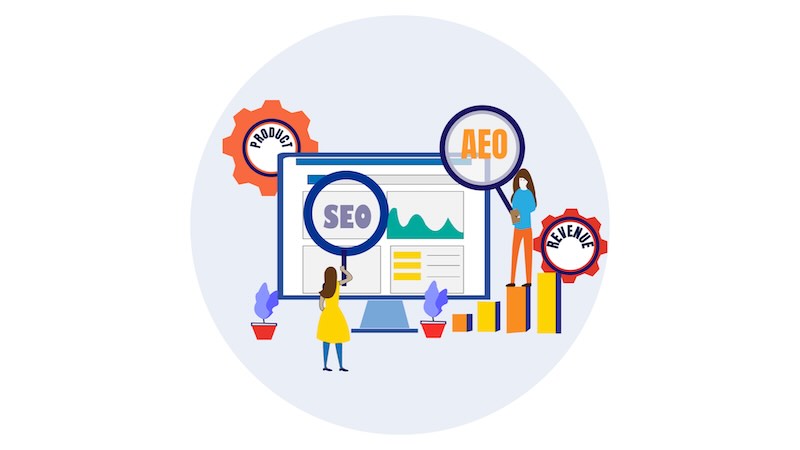
AI searches B2B content by analyzing user intent, connecting related topics, and ranking authority. It values structured, credible, and clear answers over keyword stuffing.
In other words, search isn’t about tricking algorithms anymore. AI reads between the lines, understands what people actually mean, and decides which brands have the expertise to be trusted. If your content doesn’t meet those standards, it won’t even make the cut.
AI searches B2B content in a way that makes strategic SEO even more valuable. We’re not talking about keyword spreadsheets, backlink hustles, or pumping out multiple SEO blogs, but creating high quality content that answers the readers questions. Zero-click searches are everywhere, algorithms understand intent like never before, and content that doesn’t serve both bots and humans is basically invisible.
The new reality? AI isn’t just scanning for words. It’s decoding what people mean, connecting ideas into topic clusters, checking your authority, and even tailoring results to each user’s behavior. If your content isn’t built for this, it is hard to become visible. Here’s how it actually works, why structure and trust matter more than ever, and what you need to do if you want to stand out in this AI-driven world.
Figuring Out What People Actually Want: AI Searches B2B Content with Intent
When someone types in “data integration platform comparison,” AI doesn’t just see three words mashed together. It knows that searcher is in deep research mode—comparing features, costs, maybe hunting for dealbreakers. Same with “CRM for SaaS” versus “CRM for real estate.” Those are totally different worlds, and AI gets that.
It’s the same with phrasing. “API integration for logistics” doesn’t scream “CFO problem.” It screams “developer problem.” That nuance is everything. Old-school keyword targeting would’ve treated these all the same. But the way AI searches B2B content now? It’s tuned to understand the user’s intent, not just the string of words.
That’s why your content has to solve actual problems, not just repeat buzzwords. People want quick, sharp answers up front, but also enough depth to stick around once they click. If your content is all surface-level filler, AI notices—and it won’t serve it up.
Beyond Keywords: Semantic Search and Structure Still Rule
AI search today is all about context. It’s not just asking, “Did you use the phrase ‘cybersecurity for financial institutions’?” It’s building an entire web of related ideas. It connects that search to concepts like “regulatory compliance,” “data encryption,” “threat detection.” That’s why beefy guides and pillar pages—the ones that cover every angle—still crush it. AI sees them as the go-to authority.
But it’s not just about covering topics—it’s about how you package them. AI searches B2B content by tearing through your code, not skimming your page like a human. HTML headings, subheads, lists, tables, and FAQs are its cheat sheet. Structured content is what the engine wants. A single neat comparison table or one killer paragraph can land as the featured answer, even if the rest of your piece goes in a different direction.
And let’s be honest—no one’s reading a 2,000-word post line by line. Humans scan. AI does too. So help both out: headers that make sense, bullets to highlight answers, short sections that deliver value fast. Build content in “chunks,” because AI literally breaks it up that way.
Why B2B Content Can’t Be Basic Anymore
B2B marketers, who loved their spreadsheets of keywords, backlink hustles, and endless long-tail blogs will not succeed anymore. AI doesn’t just count keywords—it actually understands what people mean.
Your content now has to do double duty:
- Give AI the snackable, structured answers it needs for snippets and zero-click results.
- Give humans the deeper context and expertise they need once they land on your page.
That’s not easy—it’s a tightrope walk. But it’s the only way forward. If you’re still writing fluff pieces stuffed with keywords, you’re wasting time.
Authority and Trust: E-E-A-T Is Watching You.
Relevance alone won’t save you in today’s AI-driven search landscape. AI systems like ChatGPT and Gemini aren’t just looking for keywords; they’re acting as detectives, vetting your content for credibility.
They’re checking for “receipts” to build a profile of your brand, and backlinks are one of the most powerful signals they use.
AI search checks if you’re credible by looking at:
- Backlinks from trusted sources: A link from a high-authority site is a powerful vote of confidence, telling AI that your content is reliable enough to be referenced by other experts.
- Author credentials: Do your authors display their expertise in their bios?
- Brand mentions: Is your brand being mentioned on forums, industry sites, or in the news? Even unlinked mentions are a signal of your authority.
If the answer to these questions is no, you’ll have a tough time ranking—and an even tougher time being cited by AI.
That’s where E-E-A-T—Experience, Expertise, Authoritativeness, and Trustworthiness—comes in. You can’t fake it anymore. AI wants proof. You need to quote studies, cite data, and demonstrate you know your industry’s lingo. Flex your connections and partnerships. Without these receipts, you’re just another voice in the void.
Personalization: The Creepy but Helpful Side
Here’s where things get a little sci-fi. AI isn’t just a cold, keyword-matching machine—it learns how people interact. If you’ve searched three case studies and skimmed two whitepapers, AI notices. Next time, it serves up something closer to what you actually want.
That means personalization. AI doesn’t just push the same answer to everyone—it tailors it. Someone in research mode gets comparisons. Someone closer to buying gets case studies or pricing breakdowns. And if your content doesn’t exist for both stages, you’re missing out.
Practical Tips: How to Get AI to Notice You
So how do you actually win in this new reality? Here’s the no-BS checklist:
- Talk like a human. Ditch the jargon. If your grandma can’t get it, simplify.
- Use keywords naturally. Sprinkle them where they make sense—AI gets context now.
- Make content scannable. Headers, bullets, FAQs, tables. Let people (and bots) find answers fast.
- Back it up. Studies, quotes, whitepapers—anything that proves you’re legit.
- Drop industry names. AI recognizes “ChatGPT,” “SEO,” “generative AI,” etc. It helps it categorize you.
- Get to the point. Quick hits for bots, depth for humans. Don’t bury the lede.
- Link smart. Build a web, not a wall. Internal and external links prove you know your stuff.
The New Reality: Be the Answer, Not Just the Option
Search isn’t just about climbing the rankings anymore—it’s about being the answer, right there, right now. Zero-click search is proof of that. If you don’t give people (and AI) what they want instantly, someone else’s content will.
Because when AI searches B2B content, it isn’t asking, “Who mentioned the right keywords most often?” It’s asking:
- Who actually understands the user’s intent?
- Who structures information clearly enough to deliver instant answers?
- Who has the credibility to be trusted?
If your content ticks all three boxes, you’re golden. You’ll not just survive AI’s takeover of search—you’ll own your space. If not, your content may find itself buried deep in search results.
FAQ:
Q: How does AI search?
A: AI search goes beyond keywords to analyze user intent. It acts like a detective, understanding what people actually mean and want. It values structured, credible content by checking for authority signals like backlinks from trusted sources and author credentials. AI breaks content into “chunks” and uses these to provide direct, often personalized, answers.
Q: What is “zero-click” search?
A: Zero-click search refers to situations where the search engine delivers a direct answer right on the results page. Users don’t have to click through to a website—the information they need appears immediately, via features like snippets or summary boxes. It’s efficient for the user, but it does mean less traffic for sites, since people get what they need without leaving the search platform.
Q: Is SEO still relevant?
A: Absolutely. SEO is not just relevant; it’s evolving fast. The old tactics—cramming keywords everywhere—are out. Now, it’s about producing authoritative, quality content that answers questions clearly and efficiently. Because AI prioritizes reliable, high-ranking sources, a strong SEO strategy focused on E-E-A-T (Experience, Expertise, Authoritativeness, and Trustworthiness) is essential. If your content isn’t up to par, you’re going to struggle to get noticed.
Additional read:
Semrush: https://www.semrush.com/blog/zero-click-searches/
Adweek: https://www.adweek.com/performance-marketing/google-zero-click-2025-seo/
Searchengineland: https://searchengineland.com/google-search-zero-click-study-2024-443869
aimX is a strategic marketing partner for B2B leaders in international Tech companies. We design marketing architectures that connect your high-level goals to daily marketing execution.
Our services are built on senior marketing experience in international consulting and technology companies. For implementation, we use AI with human oversight at every critical decision point.
The result is a marketing function that directly supports your company’s goals and translates your technology into value.
Leave a Reply